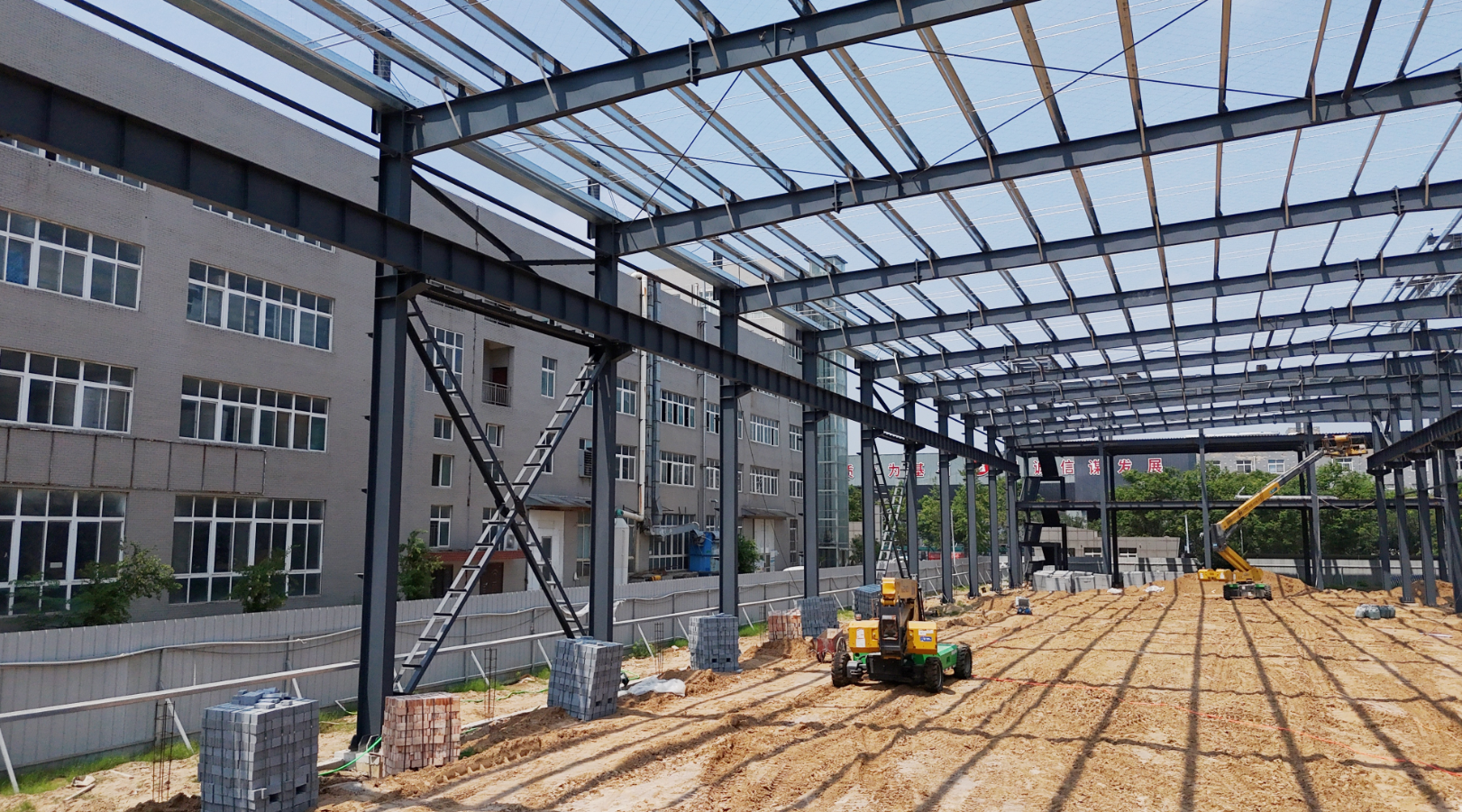
For structural engineers and commercial developers, selecting a framing system requires a rigorous balance of load capacity, material efficiency, and environmental resilience. A steel frame structure achieves primary stability through an exceptionally high strength-to-weight ratio. Structural steel is up to ten times stronger than concrete in compression and over a hundred times stronger than wood—yet weighs only about one-third as much as reinforced concrete for equivalent load capacity. This efficiency allows columns to carry heavy axial loads and beams to span longer distances with shallower sections, directly reducing foundation demands.
1. Material Consistency and Predictable Behavior Under Stress
Steel’s uniformity as a manufactured product ensures reliable, predictable performance under load. Unlike timber (with natural defects) or concrete (whose strength varies with curing), structural steel is produced under controlled mill conditions to meet exacting ASTM standards.
-
Isotropic Properties: Its elastic modulus is constant ($29,000\text{ ksi}$), and its yield strength is well-defined, simplifying complex structural analysis.
-
Controlled Ductility: Steel’s ductility allows gradual yielding before failure, providing visible warning and reserve capacity in compliance with modern safety margins.
2. Resistance to Lateral and Environmental Forces
Steel frame structures resist lateral forces through a calibrated balance of ductility and rigidity. During seismic events, steel yields plastically—sustaining large deformations while maintaining gravity-load support.
-
Seismic Performance: Special moment-resisting frames (SMF) with reduced-beam-section "dogbone" connections act as replaceable fuses. Ductility factors of 3–5 enable multiple cycles of shaking without collapse, consistent with ASCE 7-22 and IBC 2024 life-safety drift limits ($\le 0.5\%$ story height).
-
Wind Resistance: Steel’s high strength-to-weight ratio delivers stiffness without excessive mass, limiting deflection to preserve occupant comfort and façade integrity.
3. Integrated Lateral Force-Resisting Systems
A steel frame structure achieves comprehensive stability by integrating dedicated lateral systems designed to absorb and redirect wind and seismic energy:
| System Type | Primary Mechanism | Ideal Application | Key Advantage |
| Concentric Braced Frame (CBF) | Diagonal braces form a vertical truss via axial tension and compression. | Low-rise structures, pre-engineered buildings, and warehouses. | High stiffness and economical material use. |
| Eccentric Braced Frame (EBF) | Braces connect at an offset, creating a ductile "link" beam for energy dissipation. | Multi-story buildings in high-seismic zones. | Superior ductility and reliable post-yield performance. |
| Moment-Resisting Frame (MRF) | Rigid beam-column connections resist rotation without bracing. | Commercial offices and industrial facilities requiring open bays. | Maximum architectural flexibility. |
| Steel Plate Shear Wall (SPSW) | A continuous steel infill plate acts as a vertical plate girder resisting shear. | High-rise buildings demanding extreme lateral stiffness. | Exceptional initial stiffness and stable post-buckling strength. |
4. Long-Term Durability and Environmental Resilience
The longevity of a steel frame structure arises from inherent material stability and resistance to degradation:
-
Moisture & Pest Immunity: Being inorganic, steel is impervious to moisture, termites, and fungi, eliminating rot, mold, and chemical treatments.
-
Advanced Protection: Hot-dip galvanizing and advanced powder coatings provide service lives of 50–100 years even in aggressive environments per ISO 12944 C5-M.
-
Fire Resistance: While non-combustible steel loses strength above $500^\circ\text{C}$, intumescent or spray-applied fireproofing per ASTM E119 maintains load-bearing capacity for up to 3 hours (and up to 4 hours with concrete-filled steel tubes).
Frequently Asked Questions (FAQ)
-
Q: What are the core advantages of steel frame structures?
A: They offer a high strength-to-weight ratio, dimensional stability, resistance to moisture and pests, and exceptional durability under environmental and seismic forces.
-
Q: How does steel perform under seismic and wind loads?
A: Steel resists lateral forces through optimal ductility and rigidity. Systems like moment-resisting frames and braced frames ensure structural integrity and occupant safety.
-
Q: Does steel require extensive maintenance over time?
A: No, steel structures are highly durable and require minimal maintenance when protected from corrosion with coatings and regular inspections.