Understanding Load-Bearing Requirements for a Steel Structure Workshop
Cranes, Machinery, and Heavy Equipment: Static, Dynamic, and Impact Loads
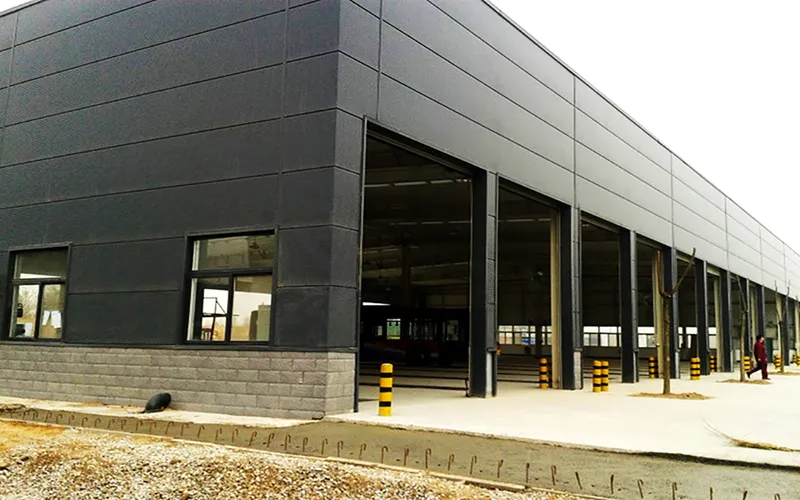
Heavy-duty steel workshops deal with three different load categories: static, dynamic, and impact, each of which uses a different foundation system.
Static loads typically include the workshop structure’s own weight, permanently attached machinery and equipment, and equipment and supplies that are stored in the workshop. Static loads require the foundation to have sufficient compressive strength to avoid settlement and maintain an even bearing surface.
Moving equipment in a workshop, such as overhead cranes, forklifts, and conveyors, create dynamic loads. Unlike static loads, dynamic loads create cyclic stresses that may cause fatigue in structural connections and the foundation. Dynamic loads require foundation systems that have sufficient lateral stiffness to withstand vibration and fatigue. This is even more critical in crane Rail systems where repeated loads create a fatigue failure.
Impact loads are typically high, short lived, and caused by sudden stops of cranes, dropping tools, and sudden surges of machinery. These loads require foundation systems designed to withstand acute loads and allow an absorbed energy without causing the columns to become misaligned.
These loads are considered together and in combination when foundation systems are designed. Load factors from ASCE 7-22 are typically applied, along with consideration for safety margins. Accurate load assessment is critical to foundation design. Under-designed systems create differential settlements that misalign crane rails and compromise the function of the doors and the flatness of the workshop floor.
Assessing Foundation Types for Steel Structure Workshop Applications
Slab-on-Grade Foundations: Achieving Uniform Support with High Load Capacity
A slab-on-grade foundation is a single reinforced concrete slab placed directly on prepared and compacted subgrade. They excel for workshops placed on stable and well-drained soils with sufficient bearing capacity (generally ≥150 kPa). It efficiently distributes column reactions, equipment footprints, and live loads to minimize concentrated stress, and thus eliminates the need for isolated footings or deep foundations.
Today’s slabs are more advanced as they allow for structural reinforcement to be incorporated to facilitate the design for integrated loads and patterns, such as the peak concentrated loads from crane wheel traffic or heavy storage racks. This type of design integrates with the embedded anchor bolt assemblies for fastening steel columns. For heavy-duty workshops with design live loads of 5–10 kN/m², a 300–450 mm thick fiber-reinforced slab, designed in accordance with ACI 360R, can be very cost effective and easy to construct. The numerous benefits include less excavation, fewer construction days, and the preservation of subgrade utilities.
On the other hand, a slab-on-grade foundation is not appropriate for sites that include highly compressible, highly expansive, or frost susceptible soils. Curling, cracking, and loss of bond with the steel frame can be effectively controlled through moisture control solutions such as a vapor barrier, perimeter drainage, and sub-base grading.
Pile and Raft Foundations: Designing for Weak or Variable Soils for Steel Structure Workshop Sites
In subsurface conditions where you encounter highly compressible, highly expansive and frost heaving soils, along with loose sands and fill materials of variable stratum, shallow foundations lead to differential settlement or excessive settlement of the structure. In such situations, pile foundations and raft (mat) foundations are appropriate solutions.
Piles—driven precast concrete, bored cast-in-place, or micropiles—carry loads of columns and equipment through weak surface layers to competent bearing strata (dense sand or bedrock). They work especially well for crane-supporting columns, where point loads are higher than 1,000 kN, and where lateral stability is a concern due to wind or seismic loads. Pile groups assist in controlling the transmission of vibrations caused by rotating machinery.
Contrarily, a raft foundation is a rigid, thickened slab (generally 600–1,200 mm) that distributes the total workshop load over a large area and “floats” on compressible soils. By balancing pressure distribution, raft foundations help reduce differential settlement (ideal for moderate terrain variability and high groundwater level sites). Rafts are effective when access to pile systems is not possible or when equipment requires specific tolerances across a uniformly stiff floor slab.
There are no prescriptive solutions to the piles versus rafts dilemma. The selection is conducted on the basis of the geotechnical investigation and structural load distribution. The construction requirements and lifecycle cost are also elements of the selection, but of lesser importance. For each choice to be properly made, a geotechnical report with borehole logs, SPT/CPT, and laboratory tests is vital. The systems should be designed for vertical, lateral, and overturning combined loads, and the effects should be considered for active seismic regions.
Incorporating Geotechnical Data into Steel Structure Workshop Foundation Design
Key Indicators From Soil Testing to Foundation Selection
Foundations are always best when designed from a geotechnical perspective. For a steel workshop, it is imperative to gather site-specific data in the soil. Designing based on regional data creates intolerable risk.
The most important parameters include:
Allowable soil bearing capacity, calculated from SPT (N-value) or CPT (qc) with field verification by plate load tests.
Soil compressibility and the modulus of subgrade reaction (ks) used in the analysis of settlement and flexural analysis of slabs.
Groundwater table fluctuation and seasonal changes used in the analysis of drainage, buoyancy, and waterproofing.
Soil expanding and collapsing, especially with clay and other fills, and the effect on structures.
Seismic site class (IBC/ASCE 7) determines ductility, anchorage, and flexibility in foundations.
These values affect the load path directly. With N₆₀ < 5 in the top 3 m and highly plastic clay, one would recommend piles. In contrast, if N₆₀ > 15 and low compressibility, one would recommend a simplified slab-on-grade with a thickened section under the crane girders.
The key part of this process is the early integration of structural and geotechnical engineering. Columns are sized, connection types are selected, and load combinations are determined before the foundation is designed. This process prevents the need for a redesign of the frame and foundation and the inadequacy of service (floor ponding or misaligned rails).
With combined knowledge of subsurface conditions, every successful heavy duty workshop starts building with confidence and ends with no compromises.
FAQ
What are static, dynamic, and impact loads in steel structure workshops?
Static loads are the weight of the structure and equipment. Dynamic loads are the movement of equipment (crane and fork lift loads). Impact loads are the loads when a piece of equipment drops or jumps (like from a machine starting).
What is a slab-on-grade foundation?
A slab-on-grade foundation consists of a reinforced concrete slab resting on compacted soil. They are good for a workshop on stable ground as they uniformly distribute the load and are economical.
When are pile or raft foundations necessary?
Pile foundations are necessary when soil is too weak to support a structure and the loads must be transferred to a deeper, more stable layer of soil. Raft foundations, on the other hand, are used in the type of soil where consolidation occurs, to decrease the settlement on the weaker soil.
Why is geotechnical data important in foundation design?
Geotechnical data helps in foundation design by analyzing the specific site conditions, so that the designer knows the soil's bearing capacities, how compressible the soil is, the location/base of groundwater, and the site's seismic classification.
How do static and dynamic loads affect foundation design differently?
Static loads and dynamic loads require very different approaches to foundation design. Static loads require that the structure be built with uniform compressive resistance of the soil to avoid settlement, while dynamic loads require that the structure be built with elements designed to resist the cyclic stress of the loads as well as be of a soil that does not consolidate too much.